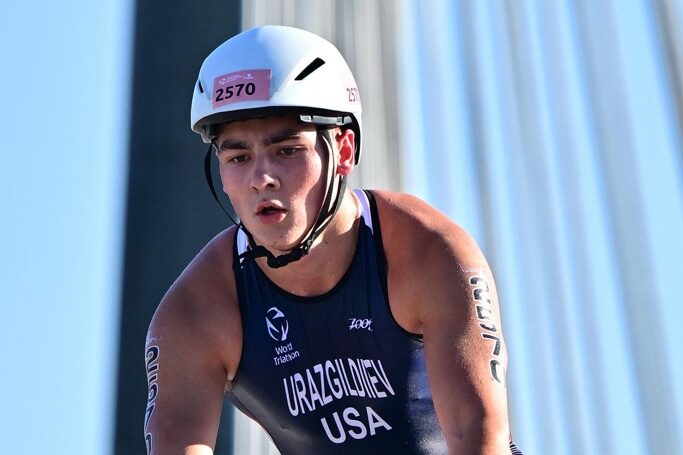
The triathlon is widely considered one of the most difficult endurance sports. The event not only tests one’s stamina but also one’s versatility in a wide range of disciplines, namely swimming, cycling, and running. Most people would shy away from such hardships. But one young Ithacan does not back down from a challenge.
Timur Urazgildiiev is only 16 years old, but he competed in multiple high-profile triathlons this past year. The first notable highlight was back in June at the USA Triathlon Long Course National Champions in Massachusetts, where he finished in first place in the 16-19 age group. On a hot and humid afternoon, Urazgildiiev was able to weather the elements and power through for an outstanding performance.
“Based on my experiences from my previous half Ironman of the season, I just decided to find a pace that works for me, take my time, try to maintain that pace and not really stray too far from it,” Urazgildiiev said.
Fast forward to September, Urazgildiiev took his talents to the global stage. He represented Team USA at the World Triathlon Championships in Pontevedra, Spain. It was a memorable experience for Urazgildiiev to race through the scenic views that European cities always offer.
“Competing there was really refreshing,” Urazgildiiev said. “It was really new. I’ve never competed in a larger city environment. We were running through the old city. A big portion of the bike was through parts of the old city and the surroundings. The view and the way the race went was really different from what I was usually used to. Then it was the aspect of racing with people from other countries because all of them had different approaches, different ways of racing. It was just nice to see it all.”
Urazgildiiev (pronounced oo-RAHZ-geel-DEE-eff) started competing in triathlons at just nine years old. Of the three legs, he began swimming at the earliest age at six years old and will be a junior on the Little Red’s swim team when they return to action in December. But running is currently his favorite part to do and feels that’s where he’s had the most growth.
“This year, I think I actually started preferring the run, especially the earlier portions of the run right after the bike just to transition the fresh feeling in your legs after you had this long, long bike course and just cruising up and down hills, taking your time,” Urazgildiiev said. “Running was just a lot of extra training, especially the leg muscles to run uphill, downhill, maintain good pace. Even though I’ve been focused more on biking in the last few seasons, I’ve improved more on my run.”
There’s unsurprisingly a ton of work that goes into preparing for triathlons. Urazgildiiev usually practices six times a week. Mondays and Tuesdays are for medium difficulty training. Wednesdays are his days to focus on swimming. Thursdays and Fridays are for higher-paced but shorter training sessions. Saturdays are for doing “bricks,” which is a combination of a long bike ride and a 10- or 20-kilometer run to practice the transition between the two legs.
With so much arduous training, the most important thing for Urazgildiiev is taking care of his body.
“The hard part for training is just making sure I don’t overdo it, especially for a big triathlon, a big race, so I have time to recover,” Urazgildiiev said. “During the actual race, it’s actually mostly the same problem. I’m feeling great during the swimming or the bikes. By the time I get to the run, if I didn’t save up my energy, didn’t take my pace properly, I’m just going to be tired by the end. It’s definitely making sure the heat doesn’t get to me, making sure I stay on my correct pace.”
Along with a strong physical aspect, the mental part of the triathlon is equally as important. Urazgildiiev’s approach is simply to do the opposite of what he’s used to doing for swimming with the Little Red.
“You want to kind of contain that adrenaline and spread it out evenly,” Urazgildiiev said. “I try to make sure I don’t overworry myself or start too fast because you have a very long race ahead of you. It’s just making sure you don’t let the adrenaline get to you. Don’t let the excitement, the worrying get to you. It’s just thinking more of it as a long practice rather than an actual race.”
As Urazgildiiev continues to compete on the national and global levels, he hopes that more people can get into doing triathlons for how incredibly rewarding it is to cross the finish line and have all that hard work pay off.
“Finishing the triathlon is always a great feeling,” Urazgildiiev said. “The feeling of satisfaction of completing it, getting the time you wanted and good-feeling aches afterwards, it’s always nice to have.”